
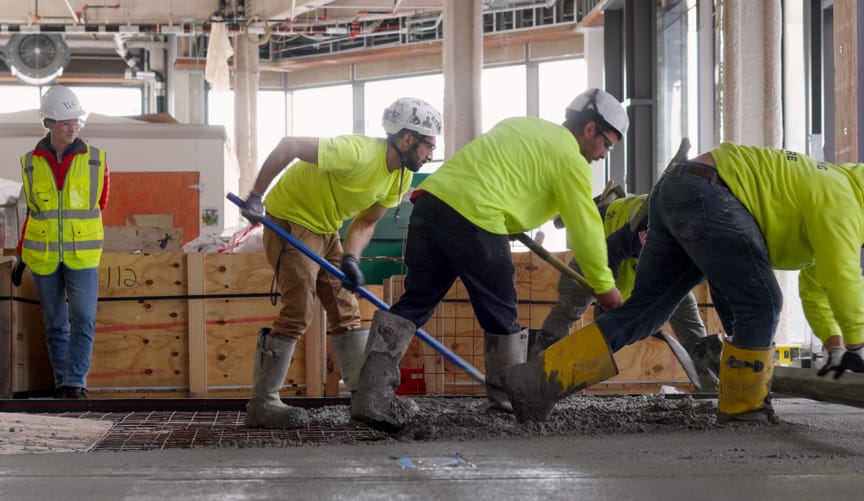
In early May, Leah Ellis, CEO of startup Sublime Systems, stood watch as crews poured and raked concrete at a construction site in Boston. Her company’s fossil-fuel-free cement had been used to make that concrete, and the moment marked an important milestone.
That’s because the three tons of cement in the concrete being formed into the floor of the indoor public space of One Boston Wharf Road, the city’s largest net-zero commercial office park project, was the first commercial applicationof Sublime’s product.
Trying to get the construction industry, which is known for being resistant to change, to embrace a novel form of cement is no small thing.
“Building owners don’t buy cement — they buy buildings,” Ellis told Canary Media. “Developers don’t buy cement — they buy concrete. And they buy it from the concrete subcontractor, who buys it from the ready-mix supplier. And there are a lot of providers in the value chain there that don’t get credit for using low-carbon cement.”
What those companies do get credit for is providing high-quality cement and concrete at reasonable cost, she said.
Sublime’s cement is made by electrically charging a bath of chemicals and calcium silicate rocks at its pilot plant in Somerville, Massachusetts. Last September, a key standards body determined that it met the same specifications as ordinary Portland cement, a material that’s produced by the hundreds of millions of tons each year in fossil-fueled kilns at temperatures as hot as molten lava.
Now Sublime is concentrating on getting the customers it needs to justify the next phase of its growth. In March, the MIT spinout won an $87 million grantfrom the U.S. Department of Energy to build its first commercial-scale plant in Holyoke, Massachusetts, capable of producing tens of thousands of tons of cement per year.